
Shopify Vape Ban 2026: What Every US Vape Seller Must Do Right Now
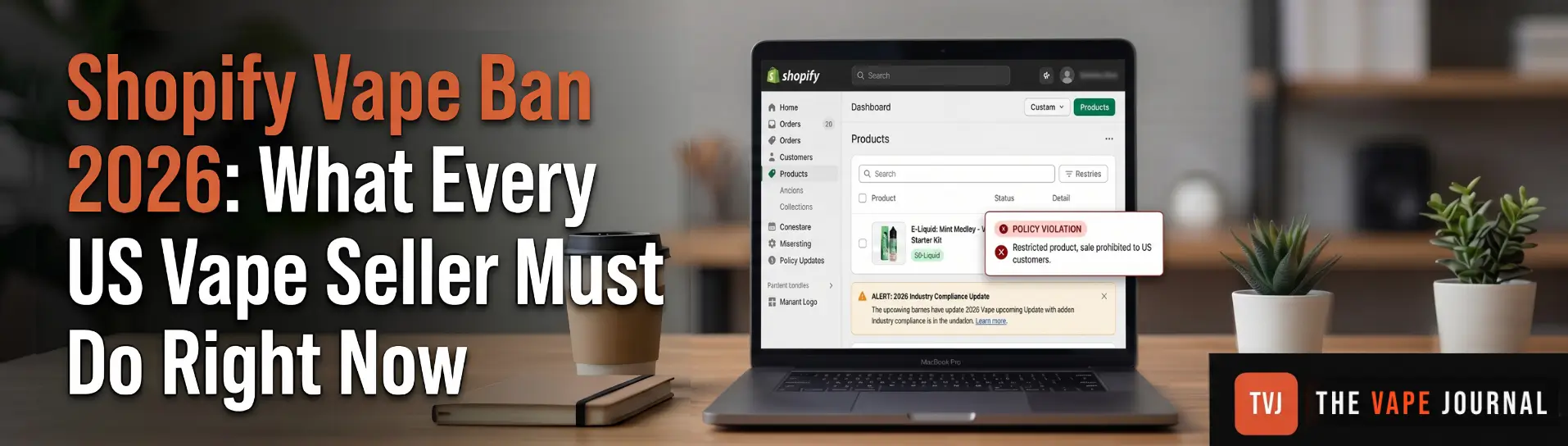
Shopify is banning all vape sales from its US platform — including FDA-authorized products. Mastercard has already warned payment partners. Twenty-five state AGs are targeting everything that keeps the vape market running. Here is the full story, what it means for you, and the exact steps sellers need to take before this week is out.
Washington D.C. / Ottawa — June 24, 2026 — On June 23, 2026, Reuters dropped a story that sent shockwaves through every vape retailer, distributor, and brand with a US Shopify presence. Shopify is banning all vape products from its platform — and the ban applies to every product, authorized or not, with no grandfather clause for the 45 FDA-cleared e-cigarettes that legally exist in the US market.
This is not a rumor, a proposed policy, or a distant threat. According to two sources familiar with the plan cited by Reuters, the Shopify vape ban 2026 could drop before the end of this week. At the same time, Mastercard has already issued a warning to its payment partners about unauthorized vape sales. The US Postal Service moved last year to block a major vape distributor. State attorneys general are writing to every financial institution they can reach.
What is happening is not a targeted enforcement action against illegal products. It is a coordinated campaign to dismantle the entire commercial infrastructure of vaping in the United States — legal and illegal alike.
- What Shopify Is Actually Doing — The Full Story
- The 25 State AGs Behind This — Who They Are
- Mastercard and Payment Rails Are Being Shut Down Too
- Who This Actually Hurts — Legal vs Illegal Sellers
- Platform Alternatives for Vape Sellers Right Now
- The Bigger Picture: Infrastructure Targeting Strategy
- Your Action Plan: What To Do Before This Week Ends
What Shopify Is Actually Doing — The Full Story
Reuters broke the news on June 23 citing two people familiar with Shopify's internal plans. The e-commerce giant — which hosts hundreds of thousands of merchants globally including a significant portion of the US online vape retail market — intends to prohibit all vape product sales from its platform, effective as early as this week.
Shopify has not made a public announcement. Its spokesperson offered a carefully worded statement: "We've always prohibited illegal activity and take action when we become aware of merchants violating our policies. We adjust our enforcement approach when legal changes call for it." The company did not deny the report and has not confirmed a timeline.
The Most Important Detail Everyone Is Missing
The Shopify vape ban will apply to all vaping products in the US — including those with full FDA marketing authorization. This is not a ban on illegal vapes. This is a ban on every vape product, full stop.
That means Glas's FDA-authorized mango and blueberry pods — which cleared the most rigorous regulatory review in US nicotine product history just seven weeks ago — will be banned from Shopify the same day as a random unauthorized Chinese disposable. The FDA cleared those products. Shopify does not care. The commercial infrastructure is being removed regardless of regulatory status.
"The ban will apply to all vapes regardless of whether they have required FDA authorization. A relatively small portion of authorized vape sales occur online, which should mean a limited effect on licensed players — but the impact on independent vape retailers will be severe."
— Reuters, citing two sources familiar with Shopify's plans, June 23 2026Does This Apply Outside the US?
Sources told Reuters it was not yet clear whether the prohibition would extend beyond the United States. For now, Shopify merchants in the UK, Canada, Australia, and other markets appear to be unaffected — but anyone running international operations on a US Shopify account should prepare for possible geographic extension as the platform tightens enforcement globally.
The 25 State AGs Behind This — Who They Are and What They Want
The Shopify vape ban did not materialize in a vacuum. It is the most visible product yet of a coordinated campaign by a bipartisan coalition of 25 US state attorneys general who have spent the better part of 2025–2026 targeting not individual illegal sellers but the platforms and financial infrastructure that allow those sellers to operate.
The strategy, led prominently by California Attorney General Rob Bonta, reflects a significant tactical evolution. Prosecuting individual vape shops and online retailers is expensive, slow, and low-yield — for every store shut down, ten more open. Pressuring the infrastructure providers — the platforms, the payment processors, the logistics networks — is far more efficient. Take out the platforms, and you take out thousands of sellers at once.
The coalition's approach has been methodical. They wrote to Shopify and similar platforms demanding action. When Shopify hesitated, they widened the net. In April 2026, Bonta and the same coalition wrote to nine major card networks and payment processors — including Visa, Mastercard, Stripe, and PayPal — demanding tougher steps to prevent their systems from handling illegal vape transactions.
The Shopify move is the most significant single victory of that campaign to date. It will not be the last.
Mastercard and Payment Rails Are Being Shut Down Too
Shopify is not the only major infrastructure provider moving against the vape category. In May 2026, Mastercard issued a global notice to its network partners — specifically to the acquiring banks and payment facilitators responsible for onboarding merchants — warning that unlicensed vape sales violate Mastercard's network standards.
The Mastercard notice, obtained by Reuters, advised acquiring institutions to strengthen merchant oversight by reviewing product inventories and monitoring transactions for compliance with applicable laws. In plain language: banks that process payments for unauthorized vape merchants are now on notice that they may be violating Mastercard's standards. That creates liability exposure for the banks, which creates pressure on those banks to terminate vape merchant accounts.
The USPS Precedent
Shopify and Mastercard are not the first pieces of infrastructure to move. The US Postal Service took action last year to block a major vape distributor from using USPS for fulfillment — part of the Prevent All Cigarette Trafficking (PACT) Act enforcement framework. That created a significant logistics disruption for online vape retailers who rely on USPS for last-mile delivery.
The pattern is consistent and deliberate: remove the platform, remove the payment, remove the shipping. The infrastructure targeting strategy is working, and it is escalating.
Who This Actually Hurts — And Who It Doesn't
The Shopify vape ban will not affect all players equally. Understanding the differential impact is critical for assessing your own situation.
| Seller Type | Shopify Ban Impact | Reason |
|---|---|---|
| Large authorized brands (BAT, Juul) | Minimal | Very little authorized vape business happens online. Sales are through licensed physical retail channels — convenience stores, pharmacy chains. |
| Independent legal vape retailers | Severe | Online sales are a primary or significant channel. Shopify is the most common platform. Losing access immediately impacts revenue, customer acquisition, and subscription orders. |
| Authorized online-first brands | Severe | Direct-to-consumer online model is the entire business model. No platform access means no sales channel while alternatives are established. |
| Illegal/unauthorized online sellers | Significant but partial | Will shift to other platforms, overseas infrastructure, or social-commerce channels. Disruption is real but not fatal for sophisticated operators. |
| Brick-and-mortar vape retailers | Low to moderate | Physical sales are unaffected. Impact depends on what percentage of revenue comes from their Shopify-based online store or click-and-collect. |
The Painful Irony for the Legal Market
The deepest irony of the Shopify vape ban 2026 is that it will hurt legal, authorized, compliant sellers far more than illegal ones. Compliant sellers have built their businesses on legitimate platforms with proper payment processing — the very infrastructure now being targeted. Illegal operators have always maintained multiple redundant channels: overseas platforms, cryptocurrency payments, cash-on-delivery networks. They will adapt faster than legal businesses that have invested in compliance.
British American Tobacco estimates the illegal US vape market at approximately $9 billion annually. The legal market — limited to 45 FDA-authorized products — is a fraction of that. The infrastructure crackdown will compress the legal segment far more aggressively than it will dent the illegal one.
Platform Alternatives for Vape Sellers Right Now
If you are operating a vape store on Shopify, you need a migration plan. Here are your realistic options, assessed honestly.
WooCommerce (Self-Hosted WordPress)
Best option for most independent retailers. Self-hosted WooCommerce on your own server gives you full control over your store — no platform can ban your products. You own the infrastructure. The trade-off is more technical responsibility: you manage hosting, security, updates, and payment gateway integration directly. For high-risk category merchants, this is increasingly the industry standard. Pair with a specialist high-risk payment processor (Easy Pay Direct, PaymentCloud, Soar Payments) rather than Stripe or standard Shopify Payments.
BigCommerce
BigCommerce has not yet announced a vape policy equivalent to Shopify's. However, given the AG coalition is targeting platforms broadly, do not assume BigCommerce immunity is permanent. It may provide a short-term bridge while you build a self-hosted solution.
Direct-to-Consumer Custom Build
For larger operations, a fully custom-built storefront on your own infrastructure is the most resilient long-term option. Higher upfront cost but zero platform dependency.
What Will Not Work
Amazon, eBay, Etsy, and every major marketplace operate even stricter age-verification and product policies than Shopify. None are viable alternatives for vape products. Do not waste time exploring those channels.
The Bigger Picture: Infrastructure Targeting Is the New Enforcement Model
Step back from the Shopify announcement specifically, and a strategic picture comes into focus. The 25 state AG coalition has figured out something important: you do not need to win in court against individual sellers to reshape a market. You need to make it impossible for sellers to operate at scale.
Platform bans remove the digital storefront. Payment processor pressure removes the ability to collect money. Logistics crackdowns remove the ability to ship. When all three are targeted simultaneously, even legal sellers face an operational crisis — not because they have done anything wrong, but because the infrastructure they depend on is exiting the category.
This model is not limited to vaping. It has been used against online gambling, adult content, and CBD products. The pattern is well-established: AG pressure, followed by platform action, followed by payment processor action, followed by logistics action. The vape industry is now in the middle of the same cycle.
The state crackdown also sits in uncomfortable tension with the federal government's recent softening. The FDA authorized fruit-flavored vapes for the first time on May 5. The Trump administration has signaled a more permissive approach to nicotine regulation. Yet at the state level, the infrastructure attack on vaping is accelerating. The result is a market where federal policy is liberalizing and state infrastructure policy is tightening — simultaneously — creating the most complex compliance environment the vaping industry has ever faced.
Your Action Plan: What Every Vape Seller Must Do Before This Week Ends
Frequently Asked Questions
When exactly is the Shopify vape ban taking effect?
Reuters reported on June 23, 2026 that the ban could take effect "as soon as this week," citing two sources familiar with Shopify's plans. Shopify has not confirmed a specific date. The Vape Journal recommends treating the ban as imminent and acting now rather than waiting for an official announcement that may not come with advance notice.
Does the Shopify vape ban include FDA-authorized products?
Yes. Sources told Reuters the ban will apply to all vapes in the US regardless of FDA authorization status. This includes all 45 FDA-authorized e-cigarettes, including the recently cleared Glas fruit-flavored pods. This is not a targeted ban on illegal products — it is a category-wide ban. Authorized sellers should not expect an exemption.
Will the Shopify vape ban apply outside the United States?
As of the Reuters report on June 23, it was not clear whether the prohibition would extend beyond the United States. Sources indicated the ban is initially a US-specific measure, but Shopify operates globally and the AG coalition could pressure for broader geographic application. Merchants in the UK, Canada, and Australia should monitor closely but are not immediately affected.
What is the best Shopify alternative for vape sellers?
Self-hosted WooCommerce on your own server is the most resilient long-term option because no third-party platform can remove your products. Pair it with a specialist high-risk payment processor rather than Stripe or standard payment aggregators. BigCommerce is a potential short-term bridge but has no guaranteed vape-friendly policy. For larger operations, a fully custom-built storefront provides maximum operational independence.
The Bottom Line
The Shopify vape ban 2026 is the single biggest platform-level disruption the US vaping industry has ever faced. It is not the end of the industry — vaping products are sold through thousands of physical retail channels that Shopify cannot touch. But for any retailer that has built an online business on Shopify, this is an emergency that requires action today, not next week.
The infrastructure targeting strategy being run by 25 state AGs is smart, legally sound, and escalating. Shopify is the first major domino. Payment processors, logistics providers, and other platforms are next in the coalition's sights. The vaping industry needs to take platform independence as seriously as product compliance — because in 2026, where you sell is becoming as regulated as what you sell.
The Vape Journal will update this article as developments unfold. Follow our vape news feed for live coverage of the Shopify ban and all related payment processor and platform actions.
Jack Ledger
Senior Vape Industry Journalist — The Vape Journal
Jack Ledger covers vaping policy, nicotine regulation, and the commercial infrastructure of the US vape market. Follow all Shopify ban developments and vape industry news at thevapejournal.com