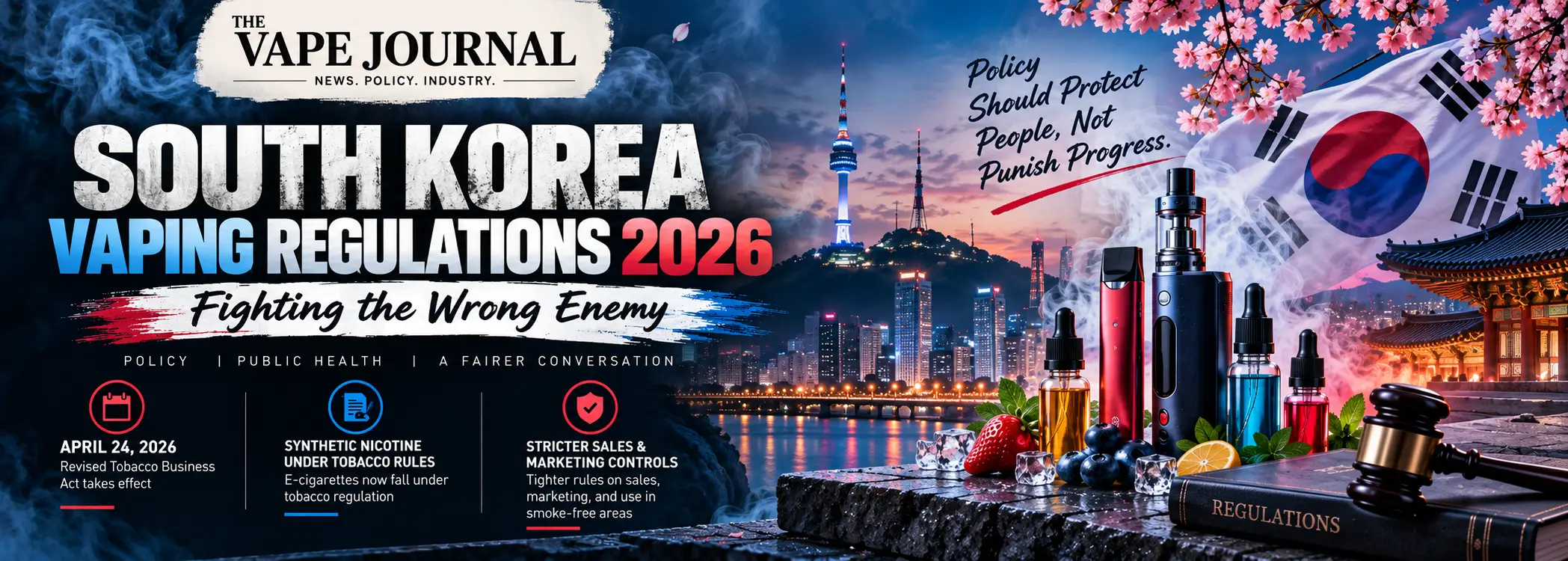
South Korea vaping regulations 2026 are under mounting scrutiny from international public health experts — and the pressure is justified. Seoul has spent three decades building one of Asia's most aggressive anti-smoking programmes: tax hikes, plain packaging, graphic health warnings, comprehensive smoke-free zones, and government-funded cessation services have all contributed to real reductions in cigarette use. But the uncomfortable truth for South Korea's policymakers is that progress has plateaued. The countries that have driven smoking rates to historically low levels didn't rely on conventional tobacco control alone — and that gap is becoming harder to ignore.
A new report from Smoke Free Sweden, Tale of Two Nations: South Korea v Sweden, has reignited a debate that increasingly uncomfortable for policymakers across Asia. Public health expert Marewa Glover, who examined the report's findings, argues that South Korea is leaving enormous public health gains on the table by failing to embrace tobacco harm reduction — the strategy of shifting smokers toward significantly less dangerous nicotine delivery methods rather than demanding cold-turkey abstinence.
South Korea's Smoking Problem: How Much Progress Has Actually Been Made?
To be fair to Seoul, the public health machinery has delivered. Tobacco taxes rose sharply in 2015, triggering a double-digit fall in cigarette sales. Smoke-free zones now cover most public indoor spaces. Health warning labels are among the most graphic in Asia. State cessation programmes provide nicotine replacement therapy at subsidised rates. By conventional measures, these are serious, sustained interventions.
The problem is that conventional measures only take a society so far. Hardened smokers — typically lower-income, higher-stress, older adults — are the most resistant to awareness campaigns and price pressure. They are precisely the population carrying the greatest disease burden from tobacco. And it is among this population that South Korea's public health gains have essentially plateaued.
Meanwhile, a 2026 study in The Lancet Regional Health – Western Pacific identified an acceleration in the pace of adult smoking decline that began around 2018 and 2019. The timing was not coincidental: it corresponded to a period of growing consumer access to e-cigarettes following regulatory changes that briefly expanded their availability. The data raised an obvious question — one that South Korea has been reluctant to fully pursue.
"South Korea is demonstrating that conventional tobacco control eventually hits a ceiling. What breaks through that ceiling, in every country that has managed it, is a meaningful shift in how nicotine products are regulated — not treated as equivalents."
— Marewa Glover, public health expert, commenting on the Smoke Free Sweden reportWhat Sweden Actually Proves — and What It Doesn't
Sweden's near-elimination of smoking is the most-cited piece of evidence in the harm reduction debate — and also the most frequently misunderstood. Proponents of harm reduction point to Sweden's extensive use of snus, a low-risk moist tobacco product, as the primary driver of the world's lowest adult smoking rate. Critics push back, noting that Swedish culture, high incomes, strong health infrastructure, and aggressive conventional tobacco control all contributed.
Both sides have a point. Sweden's success is genuinely multi-factorial. Culture and standard tobacco-control measures did matter. But here is what Sweden's data does establish cleanly: widespread availability of a lower-risk nicotine alternative does not cause a nation to trade one addiction problem for another. Swedish smoking prevalence fell to below 5% of adults while the overall rate of nicotine dependence did not escalate correspondingly. That finding directly undermines one of the most common arguments against harm reduction — that making safer products available simply creates new addicts rather than converting old ones.
For South Korea, culturally distant from Scandinavia in almost every way, the Swedish model is not a plug-and-play template. But it does demonstrate something with high relevance to any country considering its nicotine policy framework: you can have very low smoking rates and a legal, regulated market for lower-risk nicotine products simultaneously.
How South Korea's Regulatory Posture Compares
| Country | Adult Smoking Rate | E-cig Legal Status | Harm Reduction Stance | Illicit Market Risk |
|---|---|---|---|---|
| South Korea | ~20% (stalling) | Legal but heavily restricted | Reluctant / risk-averse | Moderate and growing |
| Sweden | <5% (world's lowest) | Legal; snus widely available | Harm reduction embraced | Low |
| New Zealand | ~8% and falling | Legal; regulated prescription pathway ended 2024 | Actively harm-reduction oriented | Moderate |
| Australia | ~11% | Restricted (prescription model) | Prohibition-leaning | Very high |
South Korea vaping regulations 2026 vs. peer nations
New Zealand's Experiment — A Closer Parallel for South Korea
If Sweden's cultural distance from South Korea limits direct comparison, New Zealand offers a more instructive case study. Wellington's government explicitly framed vaping as a smoking cessation tool, permitted commercial sale of e-cigarettes with age restrictions, and invested in public communication about relative risk. The result: the share of New Zealand adults smoking daily has fallen sharply — government data shows consistent year-on-year declines that are significantly faster than the pre-vaping baseline.
New Zealand's experience is not without complications. Adolescent vaping rates emerged as a genuine concern, prompting policy adjustments including stricter retail controls and a crackdown on disposable products popular with younger users. This is important context. Youth protection is not a manufactured concern — it is a real regulatory challenge that harm reduction frameworks must take seriously and address directly.
The lesson New Zealand offers is not "legalise everything and see what happens." It is that a carefully regulated, age-verified market for lower-risk nicotine products can drive smoking rates down substantially when accompanied by clear public communication about relative risk, robust enforcement of age restrictions, and ongoing monitoring of actual outcomes.
Key Findings: What the International Evidence Shows
- Countries that embrace proportionate nicotine regulation — treating lower-risk products differently from cigarettes — consistently achieve faster smoking declines than those using uniform prohibition.
- Overly restrictive regulation does not eliminate nicotine demand; it redirects it to illicit markets where no safety standards apply. Euromonitor (2026) estimated illicit e-vapour now represents over 75% of global volume.
- Sweden's sub-5% adult smoking prevalence disproves the assumption that harm reduction simply converts smokers to a different addiction at equivalent population scale.
- New Zealand's government data confirms significant declines in daily smoking since the country adopted vaping as an explicit harm reduction tool — with youth protection measures managing adolescent access risks.
- The 2026 Lancet Regional Health study found South Korea's own smoking decline accelerated during the period of greater vaping availability — providing domestic evidence the country has yet to fully act on.
The Illicit Market Nobody Wants to Talk About
Here is the piece of evidence that most frustrates advocates of strict nicotine prohibition: prohibition does not make nicotine go away. It makes regulated nicotine go away. The demand — and there is substantial, persistent demand — migrates to illegal supply chains where there are no ingredient standards, no nicotine content verification, no age checks, and no recourse when products cause harm.
Euromonitor's 2026 global e-vapour analysis estimated that illicit products account for more than three-quarters of total e-vapour volume worldwide by category. That figure reflects the cumulative effect of restrictive regulatory environments across dozens of markets pushing consumers toward uncontrolled alternatives. South Korea, with its extensive heated tobacco experience and a population already familiar with alternative nicotine delivery, is not insulated from this dynamic.
Applied to South Korea specifically: if the government continues to restrict or effectively prohibit the lower-risk products that domestic evidence suggests were helping bend the smoking curve, it does not follow that nicotine use disappears. It follows that nicotine use continues through channels the government cannot regulate, tax, monitor, or make safer.
The "Sweet Spot" Regulatory Framework — What GFN Experts Proposed
At the 2026 Global Forum on Nicotine (GFN) conference examining prohibition's role in public health, policy analyst Ondrej Koumal advanced a framework that has since circulated widely in regulatory circles. Koumal described nicotine regulation as a U-shaped problem: both extremes — a completely unregulated free market and outright prohibition — produce worse public health outcomes than a well-calibrated middle path.
The implication for policymakers is that the optimal regulatory environment is neither the Wild West nor the locked cabinet. It is a licensed, age-verified, quality-controlled market in which risk-differentiated products are available under conditions that protect youth, set quality floors, and generate the tax revenue and product data needed for ongoing oversight. Koumal's framework treats measurable health outcomes — not product categories — as the primary regulatory target.
This framing has a particular resonance for South Korea's situation. Seoul's current approach effectively treats a nicotine pouch or a well-regulated e-cigarette as if it carries the same regulatory risk as a combustible cigarette that kills half its long-term users. That equation is, by the best available evidence, incorrect — and the cost of the error accumulates every year in preventable smoking-related deaths.
What South Korea Vaping Regulations 2026 Must Change
A harm reduction pivot for South Korea does not mean deregulation. Experts in this space consistently emphasise that harm reduction done poorly can undermine both its own goals and public confidence. What the evidence supports is a package of specific, enforceable measures:
Risk-proportionate classification: South Korea should formally distinguish between combustible tobacco and significantly lower-risk nicotine products in its regulatory framework. This means different tax treatment, different advertising rules, and different retail access conditions — calibrated to evidence about actual risk profiles, not political convenience.
Strict age verification at retail: The New Zealand experience is instructive here. Age restrictions work when they are genuinely enforced. South Korea has the administrative infrastructure to require retail licensing with meaningful penalties for sales to minors. This addresses the youth access concern that critics of harm reduction raise most forcefully — and addresses it properly, rather than using youth risk as justification for adult prohibition.
Ingredient and manufacturing standards: A licensed market for lower-risk nicotine products can and should have mandatory testing, ingredient disclosure, and manufacturing quality requirements. This is precisely the regulatory infrastructure that illicit markets lack — and it is the main argument for a licensed market over prohibition.
Nicotine caps where evidence justifies them: Where evidence supports specific nicotine limits as a harm reduction measure — for example, in products specifically marketed as cessation tools — those limits can be built into the regulatory framework without blanket prohibition.
Ongoing evidence monitoring: Perhaps most importantly, South Korea should commit to a structured review process that measures actual smoking rates, youth vaping rates, illicit market activity, and health outcome data at regular intervals and adjusts policy accordingly. The goal is measurable public health improvement, not ideological purity.
Frequently Asked Questions: South Korea Vaping Regulations 2026
In 2026, South Korea permits the sale of e-cigarettes and heated tobacco products but imposes strict restrictions: nicotine content caps, comprehensive marketing prohibitions, and age verification requirements at point of sale. The core policy problem, as identified by a growing body of researchers, is that South Korea's framework treats all nicotine products — regardless of their comparative risk profiles — with essentially the same regulatory severity as combustible cigarettes. International public health experts are increasingly calling for that approach to be replaced with risk-proportionate regulation.
There is published evidence suggesting it has. A 2026 study in The Lancet Regional Health – Western Pacific identified a marked acceleration in the pace of adult smoking decline beginning around 2018–19 — a period that coincided with increased consumer access to vaping products following regulatory shifts. The acceleration subsequently slowed as policy tightened. Experts argue this sequence provides important domestic evidence that South Korea has not yet fully acted upon.
Sweden's adult smoking prevalence is below 5% — the lowest in the developed world — driven in part by widespread adoption of snus, a significantly lower-risk oral tobacco product. South Korea's adult smoking rate, while improved over two decades of policy effort, remains substantially higher and appears to have plateaued. The Smoke Free Sweden report "Tale of Two Nations: South Korea v Sweden" examines this gap and argues South Korea's conventional approach has reached the limits of what it can achieve without a harm reduction component.
Yes, and it is a growing global concern. Euromonitor's 2026 data estimated that illicit products account for over 75% of global e-vapour volume by category. Countries with strict prohibitions consistently see demand shift to unregulated supply chains — where no safety standards, age verification, or quality controls exist. South Korea's restrictive regulatory posture creates conditions conducive to exactly this outcome.
Tobacco harm reduction is the public health strategy of making lower-risk nicotine alternatives — e-cigarettes, heated tobacco, snus, nicotine pouches — available to adult smokers who cannot or will not quit nicotine entirely, with the goal of reducing the disease burden caused by combustion. For South Korea, where conventional tobacco control has stalled, harm reduction offers the most evidence-supported pathway to further progress — provided it is implemented with strong age verification, quality standards, and ongoing data monitoring rather than treated as simple deregulation.
The Bottom Line
South Korea's public health establishment has done serious work on smoking reduction over three decades. What the current evidence — both domestic and international — makes increasingly hard to defend is the philosophical equation of a lit cigarette with a regulated nicotine alternative. That equation is costing lives.
The countries that have driven adult smoking rates to historically low levels did not do it through prohibition of alternatives. They did it by managing a transition: making smoking demonstrably less convenient, more expensive, and socially stigmatised, while simultaneously making better alternatives genuinely accessible under appropriate regulatory guardrails. South Korea's domestic data, the Lancet evidence, the Swedish model, and New Zealand's ongoing experiment all point in the same direction.
The question for Seoul is not whether nicotine deserves to be regulated. It clearly does. The question is whether the regulatory framework reflects what we actually know about comparative risk — or whether it is fighting a battle against nicotine itself, at the cost of the far more winnable battle against smoking.
The evidence increasingly suggests South Korea is doing the latter. Whether its policymakers are willing to acknowledge that is a different question entirely.